Rotating an array to the right by K steps means shifting every element forward by K places, with elements at the end wrapping back around to the beginning. For example, rotating [1, 2, 3, 4, 5, 6, 7] by 3 positions gives [5, 6, 7, 1, 2, 3, 4].
To rotate an array in-place (without creating a copy of the array), we use an elegant math shortcut called the Triple-Reverse trick. Let's see how it works using a simple lazy susan turntable analogy.
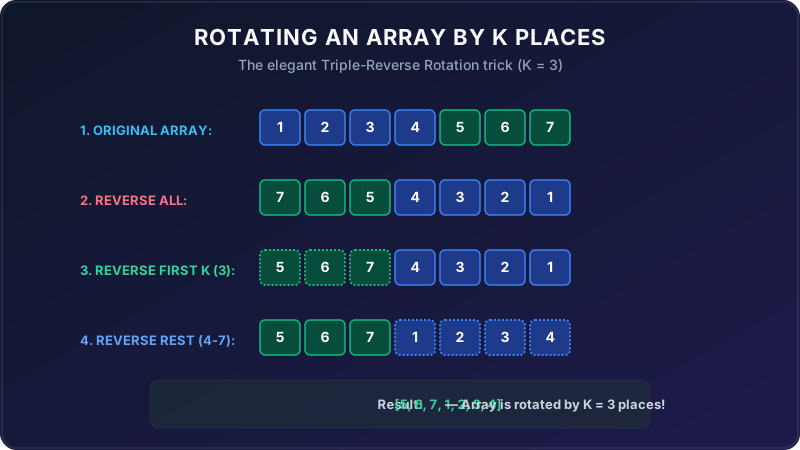
Imagine you have 7 cards labeled [1, 2, 3, 4] (blue cards) and [5, 6, 7] (green cards) sitting in a row on a turntable. You want to shift them all 3 places to the right so the green cards end up in front:
Target: [5, 6, 7, 1, 2, 3, 4]
Instead of lifting cards and shifting them one by one, you perform three simple flips:
- Flip 1 (Reverse All): Spin the entire turntable. The cards are now:
[7, 6, 5, 4, 3, 2, 1]. - Flip 2 (Reverse First K): Reverse just the first 3 cards (the green ones):
[7, 6, 5]becomes[5, 6, 7]. The cards are now:[5, 6, 7, 4, 3, 2, 1]. - Flip 3 (Reverse Remaining): Reverse the remaining 4 cards (the blue ones):
[4, 3, 2, 1]becomes[1, 2, 3, 4]. The cards are now:[5, 6, 7, 1, 2, 3, 4]!
Walkthrough of the Rotation Scenario
Let's trace how the program executes step-by-step from the entry point of the main method:
The program declares the target array and the shifting factor:
int[] arr = {1, 2, 3, 4, 5, 6, 7};
int k = 3;The program triggers the swaps in order:
- First: Reverses the whole array (indices 0 to 6):
{7, 6, 5, 4, 3, 2, 1}. - Second: Reverses the first 3 elements (indices 0 to 2):
{5, 6, 7, 4, 3, 2, 1}. - Third: Reverses the remaining 4 elements (indices 3 to 6):
{5, 6, 7, 1, 2, 3, 4}.
Java Implementation
Below is the complete Java code demonstrating in-place array rotation:
package io.practise.accolite;

import java.util.Arrays;

public class RotatingArrayKTime {

    public static void main(String[] args) {
        int[] arr = {1, 2, 3, 4, 5, 6, 7};
        int k = 3;

        rotate(arr, k);

        System.out.println(Arrays.toString(arr)); // Outputs: [5, 6, 7, 1, 2, 3, 4]
    }

    public static void rotate(int[] nums, int k) {
        k = k % nums.length; // handles cases where k is larger than the array length
        reverse(nums, 0, nums.length - 1); // Step 1: reverse all
        reverse(nums, 0, k - 1);           // Step 2: reverse first K
        reverse(nums, k, nums.length - 1); // Step 3: reverse the rest
    }

    private static void reverse(int[] nums, int start, int end) {
        while (start < end) {
            int temp = nums[start];
            nums[start] = nums[end];
            nums[end] = temp;
            start++;
            end--;
        }
    }
}
Conclusion
The Triple-Reverse algorithm rotates arrays in O(N) time complexity and O(1) space complexity. It is the most memory-efficient way to shift collections of data without needing temporary placeholder arrays!