Setting acks=all on your producer is the first step toward preventing data loss. But did you know that acks=all by itself **does not guarantee that your message is replicated**?
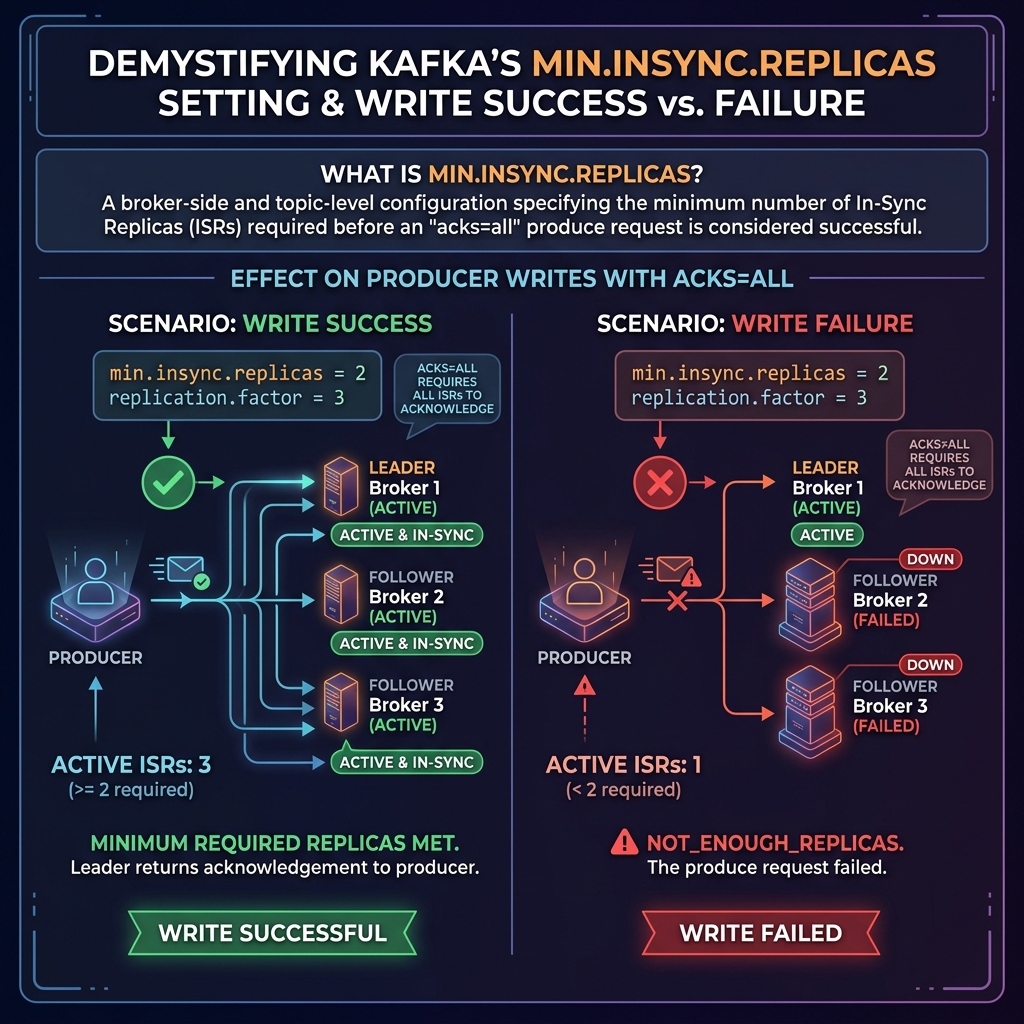
If your replication factor is 3, but 2 of your brokers crash, only 1 broker remains online. In this scenario, writing with acks=all will succeed after writing to the single remaining leader. If that broker then crashes, your data is gone forever. This is where min.insync.replicas becomes essential.
Imagine a company bank account that normally requires **three executors** to approve a check (Replication Factor = 3).
If two executors go on vacation, you only have one executor left. If you write a check, the single remaining executor signs it and releases the funds. However, having only one signature is highly risky (single point of failure).
To protect yourself, you establish a **co-signing rule**: "No funds can be released unless at least *two* executors sign the document" (min.insync.replicas = 2). If only one executor is in the office, the system rejects the transaction, preventing risky payments until a second executor returns.
What is min.insync.replicas?
The min.insync.replicas variable is a broker/topic level configuration. It defines the minimum number of In-Sync Replicas (ISR) that must acknowledge a write for the write to be considered successful, **but only when the producer writes with acks=all**.
If the active ISR count falls below this limit, the broker rejects the write request and throws a NotEnoughReplicasException (or NotEnoughReplicasAfterAppendException) to the producer client.
The Golden Rule of Production Safety
For mission-critical data pipelines that require absolute zero data loss, use the following configuration layout:
- Replication Factor (RF): 3 (Ensures 3 copies of data exist across 3 brokers).
- min.insync.replicas (minISR): 2 (Ensures at least the leader and 1 follower must write the message before confirmation).
- Producer acks: all (Forces the producer client to wait for this replication confirmation).
With this setup, you can tolerate **one broker failure** with zero data loss. If one broker fails, the ISR count drops to 2. Writes continue succeeding because the minISR limit of 2 is met. If a second broker fails, the ISR count drops to 1. Writes are rejected, protecting your data integrity by refusing to write to a single remaining node.
Example Configuration
In your broker's server.properties file, or when creating a topic, you define this limit:
# Set global default in server.properties
min.insync.replicas=2
You can also alter this setting programmatically on a specific topic:
Map<ConfigResource, Collection<AlterConfigOp>> updateConfigs = new HashMap<>();
ConfigResource resource = new ConfigResource(ConfigResource.Type.TOPIC, "payments");
AlterConfigOp op = new AlterConfigOp(
    new ConfigEntry("min.insync.replicas", "2"),
    AlterConfigOp.OpType.SET
);
updateConfigs.put(resource, Collections.singletonList(op));
adminClient.incrementalAlterConfigs(updateConfigs).all().get();
Conclusion
Data durability in Kafka is a team effort. Always pair your producer's acks=all with a topic-level min.insync.replicas=2 policy to prevent single-point-of-failure writes and build a truly resilient data architecture.